Community health clinics rarely operate alone. They depend on partnerships with universities, nonprofits, volunteers, and local service organizations. If you are researching who the affiliates for Mabuhay Health Center are, understanding this network helps clarify how the clinic delivers culturally responsive care to underserved communities.
Mabuhay Health Center (MHC) is not a traditional hospital system with corporate branches. Instead, it operates through academic partnerships, community organizations, national nonprofit alliances, and multidisciplinary volunteer professionals. These affiliates collectively support screenings, outreach programs, medication counseling, behavioral health services, and culturally sensitive care delivery.
Patients, volunteers, students, and healthcare researchers often search for affiliate details because they reveal credibility, training opportunities, and service scope. Affiliations also explain how a volunteer-run clinic maintains clinical quality while expanding services across neighborhoods.
This guide explains the verified affiliates of Mabuhay Health Center, how they contribute to operations, and why they matter for patients and healthcare trainees alike.
Contents
Who are the affiliates for Mabuhay Health Center?
Snippet Answer: Mabuhay Health Center affiliates include the University of California, San Francisco (UCSF); Bayanihan Community Center; Bessie Carmichael School Filipino Education Center K-8; Canon Kip Senior Center; and the National Association of Free and Charitable Clinics. Additional affiliates include volunteer physicians, pharmacists, nurses, community health advocates, and allied health professionals supporting culturally responsive care delivery.
These affiliates form a collaborative ecosystem that allows Mabuhay Health Center to operate as both a clinical service provider and a training hub for future healthcare professionals. Rather than functioning independently, the clinic integrates academic supervision, community outreach networks, and national nonprofit standards.
Academic partners supply trained students and supervising clinicians. Community organizations provide facilities and outreach access. National associations strengthen compliance and credibility. Together, these relationships expand services without increasing patient cost.
Understanding this structure clarifies why Mabuhay Health Center remains one of the most recognized Filipino-focused community clinics in San Francisco’s South of Market district.
What is Mabuhay Health Center and why does it rely on affiliates?
Answer Block: Mabuhay Health Center is a volunteer-run community clinic serving underserved Filipino-American residents in San Francisco’s South of Market district. It relies on academic institutions, nonprofit partners, and community organizations to provide clinical supervision, outreach access, facilities, and multidisciplinary healthcare services.
Mabuhay Health Center operates differently from traditional clinics. It was established to address culturally specific healthcare barriers affecting Filipino-American seniors and families. These barriers include language gaps, stigma surrounding mental health, and limited preventive care access.
Because the clinic is volunteer-driven, partnerships are essential. Academic affiliates provide licensed supervision. Community centers host programs. Nonprofit associations support outreach coordination. Without these collaborators, the clinic would not sustain regular service delivery.
Affiliates also expand the clinic’s educational mission. Students from medicine, pharmacy, dentistry, and nursing programs gain hands-on experience in culturally responsive care. This strengthens both patient services and professional training pathways.
In short, Mabuhay Health Center’s affiliate network ensures the clinic maintains quality care while remaining accessible and community-focused.
Which academic institutions are affiliated with Mabuhay Health Center?
Answer Block: The primary academic affiliate of Mabuhay Health Center is the University of California, San Francisco (UCSF), including its Schools of Medicine, Pharmacy, Dentistry, and Nursing. These programs provide student volunteers, faculty supervision, and interdisciplinary training support for clinic services.
Academic partnerships form the backbone of Mabuhay Health Center’s clinical operations. UCSF students and faculty regularly participate in screenings, medication counseling, behavioral health assessments, and preventive education programs.
These partnerships provide three essential benefits. First, they ensure medical oversight meets professional standards. Second, they expand service capacity without increasing operational costs. Third, they create experiential learning opportunities for future healthcare providers.
Faculty mentors supervise treatment plans and ensure safety compliance. Pharmacy students assist with medication adherence counseling. Nursing students help monitor vitals and preventive care education. Dental trainees support oral health screenings.
This interdisciplinary environment improves patient outcomes while preparing students to serve diverse populations in community settings.
What community organizations partner with Mabuhay Health Center?
Answer Block: Mabuhay Health Center partners with the Bayanihan Community Center, Bessie Carmichael School Filipino Education Center K-8, and Canon Kip Senior Center. These organizations provide outreach support, clinic space, youth education programs, and access to elderly Filipino residents needing culturally appropriate care.
Community organizations extend the clinic’s reach beyond traditional healthcare settings. Instead of requiring patients to travel long distances, services are delivered within familiar neighborhood spaces.
The Bayanihan Community Center serves as a cultural anchor for Filipino-American residents. It supports outreach coordination and strengthens trust between patients and providers.
Bessie Carmichael School collaborates with Mabuhay Health Center on youth education workshops. These initiatives teach preventive care habits early and connect families with screening opportunities.
Canon Kip Senior Center hosts monthly clinic sessions serving elderly residents. Seniors often face transportation challenges, so delivering services directly within their community improves participation rates.
These partnerships demonstrate how location-based affiliates enhance accessibility and engagement.
Does Mabuhay Health Center work with national healthcare organizations?
Answer Block: Yes. Mabuhay Health Center is affiliated with the National Association of Free and Charitable Clinics (NAFC), which connects volunteer clinics across the United States through shared standards, advocacy initiatives, and best-practice resource networks.
National affiliations strengthen institutional credibility. Membership in NAFC signals adherence to recognized volunteer clinic governance standards and patient service practices.
This connection also provides access to policy advocacy support addressing healthcare disparities. Free clinics often face funding and regulatory challenges, so national alliances help protect operational continuity.
Additionally, NAFC membership enables collaboration with similar clinics nationwide. This improves knowledge sharing related to preventive screening programs, chronic disease management strategies, and culturally responsive care models.
For patients and volunteers alike, national affiliations reinforce confidence in service quality.
What roles do volunteer clinicians play as affiliates?
Answer Block: Volunteer physicians, nurses, pharmacists, dentists, and behavioral health specialists serve as clinical affiliates of Mabuhay Health Center by delivering screenings, consultations, medication counseling, and preventive education under supervised interdisciplinary care frameworks.
Volunteer clinicians form the operational core of Mabuhay Health Center. Without them, service delivery would not be possible.
These professionals contribute across multiple specialties. Physicians conduct diagnostic consultations. Pharmacists support medication management. Behavioral health counselors address mental wellness needs.
Dental volunteers provide oral screenings often unavailable in free clinics. Nursing professionals monitor patient vitals and preventive risk indicators.
- Primary care consultations
- Medication adherence counseling
- Mental health screening services
- Dental wellness checks
- Chronic disease education programs
Together, these roles create a multidisciplinary support system addressing both physical and behavioral health challenges.
How do community health advocates support Mabuhay Health Center affiliates?
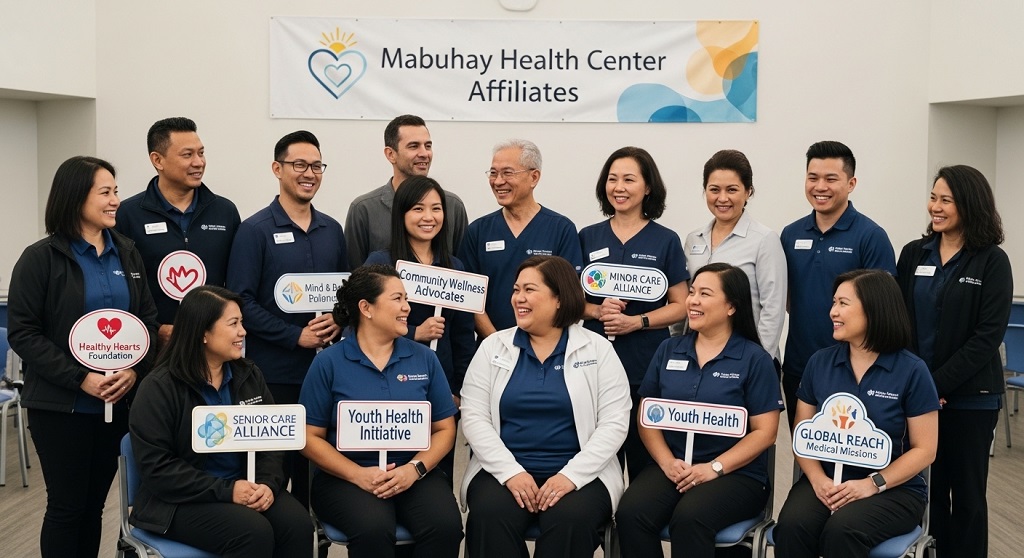
Answer Block: Community health advocates affiliated with Mabuhay Health Center support outreach programs, translation services, workshop coordination, and referral navigation. Their involvement improves access for underserved Filipino-American residents facing cultural or language barriers.
Community advocates play a crucial bridging role between patients and healthcare providers. Many residents hesitate to seek care due to stigma or unfamiliarity with medical systems.
Advocates organize educational workshops explaining preventive screening benefits. They assist patients in scheduling appointments and navigating referral systems.
They also help translate culturally sensitive health information into familiar language contexts. This ensures patients fully understand treatment recommendations.
These affiliates strengthen trust and improve long-term engagement with healthcare services.
Which allied health professionals are part of the affiliate network?
Answer Block: Allied health affiliates include nutritionists, physical therapists, behavioral health specialists, and medication therapy counselors who support chronic disease prevention, rehabilitation guidance, and lifestyle education programs at Mabuhay Health Center.
Modern community clinics require multidisciplinary care models. Allied professionals expand treatment beyond diagnosis alone.
Nutrition specialists help patients manage diabetes and hypertension through dietary planning. Physical therapists assist mobility improvement among elderly patients.
Behavioral health providers address anxiety, depression, and stigma-related concerns affecting treatment adherence.
Medication therapy counselors ensure patients understand prescription schedules and side-effect risks.
| Affiliate Category | Examples | Primary Contribution |
|---|---|---|
| Academic Institutions | UCSF Schools of Medicine, Pharmacy, Dentistry, Nursing | Clinical supervision and training |
| Community Organizations | Bayanihan Community Center, Canon Kip Senior Center | Facilities and outreach access |
| Education Partners | Bessie Carmichael School Filipino Education Center | Youth health programs |
| National Networks | NAFC | Policy advocacy and standards |
| Volunteer Specialists | Doctors, nurses, pharmacists | Direct patient care |
Why do affiliates matter for patients and volunteers?
Answer Block: Affiliates strengthen Mabuhay Health Center by expanding services, improving clinical oversight, increasing outreach capacity, and supporting culturally responsive care. These partnerships allow the clinic to deliver multidisciplinary healthcare while remaining accessible and free to underserved communities.
Affiliates determine service quality in volunteer clinics. Academic supervision ensures treatment accuracy. Community partners increase participation rates. National organizations strengthen accountability.
- They increase screening availability
- They improve referral coordination
- They support culturally sensitive communication
- They expand preventive care education
Patients benefit through coordinated services. Volunteers benefit through supervised training opportunities. Communities benefit through improved long-term health literacy.
Together, affiliates transform Mabuhay Health Center from a small clinic into a comprehensive community health network.
Conclusion
Understanding who the affiliates for Mabuhay Health Center are reveals how community-driven healthcare actually works. The clinic’s partnerships with UCSF, Bayanihan Community Center, Canon Kip Senior Center, Bessie Carmichael School, NAFC, and multidisciplinary volunteer specialists create a strong support ecosystem serving underserved Filipino-American residents.
These affiliations ensure clinical oversight, expand outreach, and improve access to preventive services. They also support culturally responsive care models tailored to community needs rather than generic healthcare delivery frameworks.
If you are considering volunteering, collaborating academically, or seeking services, reviewing these affiliates provides confidence in the clinic’s structure and mission alignment.
Explore partnership opportunities, attend outreach programs, or connect with affiliated organizations to become part of a healthcare network focused on equity and accessibility.
Frequently Asked Questions
Is Mabuhay Health Center part of UCSF?
Mabuhay Health Center is not owned by UCSF, but it is closely affiliated with UCSF schools and faculty who supervise student volunteers and support interdisciplinary clinical services.
Where is Mabuhay Health Center located?
The clinic operates primarily in San Francisco’s South of Market district and provides services through community partner locations such as Canon Kip Senior Center.
Does Mabuhay Health Center charge patients?
No. Mabuhay Health Center provides free healthcare services supported by volunteers, academic institutions, and nonprofit affiliates.
Who funds Mabuhay Health Center programs?
Funding comes from community sponsors, grants, nonprofit partnerships, and institutional support from affiliated academic and charitable organizations.
Can students volunteer at Mabuhay Health Center?
Yes. Students from medicine, pharmacy, dentistry, and nursing programs regularly volunteer under faculty supervision as part of affiliated academic training programs.
What services do affiliate clinicians provide?
Affiliate clinicians provide screenings, medication counseling, behavioral health assessments, preventive education, and referral coordination services.
Why are community organizations important affiliates?
Community organizations provide trusted access points for patients, improve outreach effectiveness, and host culturally appropriate health education programs.
Read More Also: How to Increase Energy Without Sugar: Natural Ways
Learn More: How to Perform Neck Hump Exercises as Part of Morning Routine